Observe
See available traffic observations beside a defined drone operation.
Sentryn Airspace / Operations governance
Explore how airspace observations, own-drone telemetry and operational constraints can support a responsible operator — with the context behind each warning kept visible.
Illustrative scenario · Synthetic data · Operator-led decisions
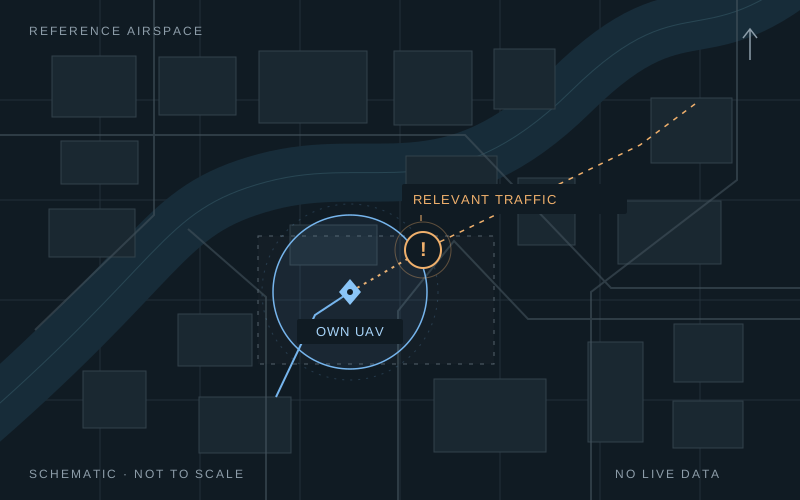
SCHEMATIC REFERENCE · NO LIVE DATA · NOT TO SCALE
Public demonstration of passive airspace monitoring, proximity warning and data-quality limitations using fully synthetic inputs. This is not a live service, measured deployment, flight authorisation or collision-prevention claim.
Airspace experience / Dynamic Airspace Protection
Five narrative chapters use three unchanged reference snapshots. Map, warning basis, data quality and illustrative event detail stay linked to the same source state. Press Play or select a chapter.
Synthetic example only. No measured timestamps, policy-rule version, cryptographically committed evidence, operator response or operational minimum is claimed.
A static warning snapshot is available. Interactive chapters load only when the synthetic scenario files can be validated. No connection to a live airspace feed is made.
The original three-state demonstration remains available: Open the original illustrative airspace scenario ↗
Why runtime governance matters
See available traffic observations beside a defined drone operation.
Assess a synthetic observation against the illustrated protection envelope.
Surface a bounded, explainable advisory warning to the responsible operator.
Keep the reason, source-state quality and representative event information inspectable.
Missing data is not clearance.
Separate an observation, its interpretation and the decision that remains with the operator.
Identify stale observations and avoid treating a missing feed as a resolved warning.
Relate a synthetic warning to the corresponding source state and assessment basis.
Integration / Responsibility
Available cooperative traffic data, own-drone telemetry and operation-specific rules. Suitability depends on source coverage, timeliness and data permissions.
Evaluate a defined monitoring condition, express the warning reason and expose relevant context for review. Advisory monitoring does not imply execution authority.
The operator assesses the warning and remains responsible for any flight decision. Flight commands stay in the existing control system.
Illustrative scenes only; no vendor coverage, customer endorsement, pilot acceptance, regulatory clearance or commercial SLA is implied.
From operating question to evaluation
For drone operators, public-safety teams and system integrators evaluating advisory airspace monitoring. Begin with one operation and a warning condition that can be inspected.
Which traffic observations or changing operating boundaries should prompt an operator review? Agree the monitored area, relevant traffic and the limits of the available data.
Own-drone telemetry, permitted traffic observations, timestamps and a defined operating envelope. Confirm coverage, freshness, usage rights and the meaning of missing data before relying on a feed.
The proposed Sentryn layer evaluates the agreed condition and explains its basis. The operator decides what to do; flight commands remain in the existing control system.
A scenario set with expected warnings, stale-data cases and a traceable record linking inputs to each assessment. Distinguish synthetic replay, live observations and measured results in the acceptance report.
Current public evidence: an illustrative scenario using synthetic inputs. A live pilot, warning performance, data coverage and operational acceptance must be agreed and validated separately.
Read the governability assurance research ↗Scope an evaluation ↗
Agree the data inputs, warning conditions and evidence required for a bounded pilot.